Great time to be alive

Seattle
The Seattle area has its share of problems. High cost of living. A moribund downtown. Homelessness. High government spending with insufficient results. The Mariners. As the fall rains start to arrive, it is easy to become grumpy.
But then this study comes out — Seattle Ranks 4th in Oxford Economics Top Global Cities of 2026 : r/Seattle. You can quibble with the exact ratings, and maybe #4 is too high. And we can do better, and we should aspire to really earn that #4 spot through better governance, smarter spending, greater affordability, easier job creation, better safety nets, etc.
But we live in an exceptional place at an exceptional time, and we’ve no reason to be grumpy about anything.
USA! USA!
Economically, by some measures the US is doing great too. Money is flowing into the US equity market at a high rate. There are a lot of reasons why this might be great news — the USA is dominant in AI, there is a lot of confidence in US growth prospects compared to the rest of the world, it is a healthy flow of money into private enterprise instead of government bonds.
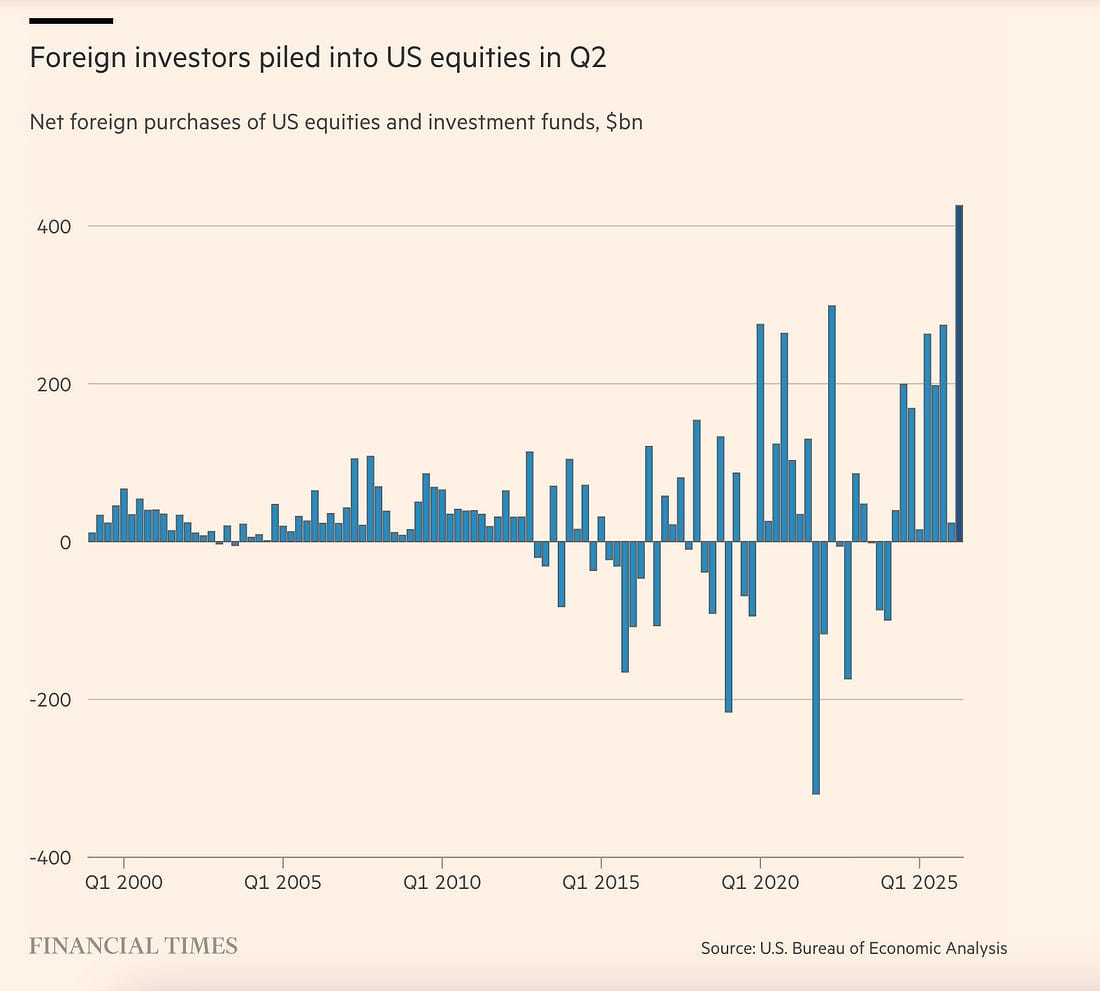
(There is also a counter story — the dollar has lost a lot of value, and continues to lose value, under the guidance of the Trump/Vance administration and their clown Scott Bessent. And so US assets are getting cheaper, and US citizens are quietly losing purchasing power.)
Biggest economic shift ever
Whatever the reason, an exceptional amount of capital is being invested. The AI Build-Out Is Becoming the Biggest Economic Bet in U.S. History — total available AI capacity is expanding at a historic rate; this is a transformation bigger than railways, electrification, the internet, etc.
And the cost to use AI continues to plunge: Over the past three years, the cost of a given level of AI performance has fallen about 47% per quarter, faster than for any other transformative technology in history.
AI capacity is growing so fast that you feel stupid if you are not using it, but at the same time, if a particular problem seems hard to solve with the AI tools of today, the best strategy might be to just wait — Whatever program is hard to build now will be trivial soon, so if there's something you want to see, you can just wait for it.
Meta
I’ve started using Muse regularly. As the AI tools have evolved, I have been building the same app repeatedly — an AI-based guide to our house, based on the 25 years of email and documents I have covering the original design plans, site work, construction, maintenance, furnishings, bills, etc. I’ve gone through many approaches to building the app — RAG, graphs, MCP servers, agents, etc. Muse is close enough now that I don’t really have to build an app anymore; I can just point Muse at my folder of email and docs. It’s slower than a purpose-built solution, but accuracy is as good or better, and I bet the speed difference goes away in time.
I’ve been a Meta user for a long time — I joined Facebook as soon as it opened to non-students. I have accounts on all their social media properties tho I am not extremely active. I’ve generally been pretty skeptical of the company. The negative impact of social networks has been discussed at length. The Careless People book, even if only partly accurate, is pretty damning about the company’s behavior.
But I am dealing with some cognitive dissonance now. Muse is very helpful. I am sure other companies will offer great personal agents (hello Dots), and I look forward to more alternatives here, but Muse is a great start.
Threads is so much better than what Twitter has become. I like my Ray-Ban Meta glasses. They are good glasses and nice audio devices. It is smart to embed intelligence and features into a wearable that society has already accepted.
So I find myself spending time with Meta products frequently throughout the day. I didn’t expect this.
25 years ago, almost all my time was spent in the Microsoft and Windows ecosystem. I used Windows every day, Microsoft Office every day, Microsoft browsers and email clients, Microsoft mail services. I played PC Games built on Microsoft’s DirectX platform.
Now my most-used vendor list looks very different:
- Apple. I have hourly engagement with Apple products. I have largely favorable views of the company.
- Meta. I have hourly engagement with Meta products, trending upwards. I am deeply skeptical of the company and am confused.
- Google. I have daily engagement with Google products, but trending downward. My search use is collapsing as AI replaces it. Email is still Google, but that is purely inertia, and I may pull my email off to another solution.
- OpenAI and Anthropic. Daily use of their products, bouncing between the two. I love their innovation.
- Amazon. Daily engagement, trending down. I don’t directly engage with AWS anymore; I let my coding agents figure out hosting issues. I’m pulling away from Amazon.com as I can; their blocking of agents seems counterproductive. I am a Kindle-using dinosaur, but family is pushing me towards Libby
- Microsoft. I have weekly engagement with Microsoft products, trending downward. No Office license anymore. I haven’t opened VS Code in a week or more. I have favorable views of the company — but they have fumbled the AI transition.
I am again surprised at how much I am using Meta products. And surprised at how far and how fast Microsoft usage has fallen.
The US Senate
As previously mentioned, we are in the midst of a massive economic shift. And besides that, we are in an undeclared war; mortgage rates are at 7% and climbing; the dollar is losing value monthly; our international relationships are collapsing; we have masked secret police dragging people off the streets. Lots of big meaty issues for the Senate to discuss and work on; the Senate styles itself as “the greatest deliberative body on earth”. A noble goal, and we should hold them to that aspiration!
So this week, the Senate passed the Protect College Sports Act, wading into the critical issue of how to split the college football revenue pie. First, I’m with Cory Booker — “This so-called “Protect College Sports Act” isn’t about protecting college athletes—it’s about protecting wealthy coaches, powerful institutions, and an NCAA that’s held unbridled power for decades while athletes faced discrimination and injustice.” It is legislation designed to keep the money in the hands of the NCAA and large institutions at the expense of athletes.
This is a bad law. It is a naked attempt to keep the money in the sport in the hands of powerful institutions, while denying the players that money and denying them any say over it. Will Leitch in The Athletic:
What do the athletes want? What are their needs? What would be fair for them? No one has asked. And it’s because no one cares.
College athletics is treated as a massive business and lifelong vocation for everyone involved in it except for the actual humans who play it, who are seen instead — still, after all this time — as temporary bystanders, fortunate enough to be allowed to take part in this activity but given no autonomy or agency in how the activity is governed itself. They are treated like children who cannot speak for themselves and thus require the adults to make all the decisions for them — and to scold them when they disappoint.
This is dumb legislation and an embarrassing use of the Senate's time. Our Senator, Maria Cantwell, should be ashamed of leading this thing while she has been invisible on every other issue of consequence.