Interesting Times
This week in AI
Vlad pointed me to this article — Quantum Chemistry: AI and Quantum Transform Research - IEEE Spectrum. It is super exciting: the combination of AI “reasoning” and quantum-accurate data can find and evaluate novel molecules and materials. I’ve always been inspired by Feynman’s “There’s plenty of room at the bottom” — we have a great opportunity ahead of us. AI has already proven to be great at really high-level tasks like coding, and it looks like it can help at the lowest level of material design.
And for high-level tasks, like everyone else, I am using Claude and dabbling with Claude Cowork. For coding projects, Claude does a great job of organizing work, building plans, addressing test issues, and reviewing work. I can’t imagine working without an assistant like this. It is so good that I am increasingly defining all my investigative projects and research as coding projects, because Claude can be applied to them easily and directly.
For instance, I read this article a week or so ago on the income tax debate in Washington — Opinion: Here’s what’s missing from the tax debate in Washington state. The author argues that we are missing a coherent view of all taxes in the state:
What is the state’s target tax burden as a percentage of income? How should it compare to states Washington actually competes with — California, Texas, Colorado, Oregon, Arizona? Should Washington aim to be a low-tax state, a middle-of-the-pack state, or a high-tax state that promises high-end public services? Voters are never told.
This is a reasonable question, and yet the author provided no answers. I could have done some research on this, but it was easier to just treat it as a coding project, and so here is my first version of a state tax load comparison tool. I’ll be adding comparisons on a percentage-of-income basis, and then I want to drill into state spending and spending effectiveness. This was all generated with Claude in a pretty vibe-y way. Would have taken me weeks in the past.
Reading
I read a lot, and I am always considering how to get more out of my reading. From Ted Gioia’s My 24 Rules for Reading — the three that stick with me:
Always bring a book with you. When other people are forced to wait in line or sit in the waiting room, they get irritated and impatient. But I am happily engaged in my book. This adds to my serenity.
Make time to read books by people who have different opinions than your own, but always seek out the best examples by the smartest writers. This will allow you to pressure test your own thinking, and teach you tolerance for those with different life experiences and world views.
Find opportunities to talk with others who love books. These will often turn into lasting friendships with the finest companions.
I’m currently reading An African History of Africa and 1929: Inside the Greatest Crash in History – and How It Shattered a Nation, both provide excellent perspective. And my book club will be discussing 1929, so looking forward to how others react to it, and what lessons we can draw from it for current times. There are certainly some themes that rhyme – the rampant stock speculation of the late 1920s compares to the rampant crypto and prediction market speculation of our own times.
How is the Trump administration doing?
Not so great on public health — from The Lancet —Robert F Kennedy Jr: 1 year of failure:
To the Senate committee who confirmed his nomination, Kennedy promised a receptive and collaborative relationship, and to the public from whom he claims his mandate, he promised a new era of unbiased science without hidden conflicts of interest, secrecy, or profiteering. Radical transparency, gold-standard science, ethics, compassion, competency, and pride would restore to HHS the unimpeachable authority that the USA needs and deserves. Politicians are known to break promises, but Kennedy's record, 1 year in, has been a failure by most measures, especially his own.
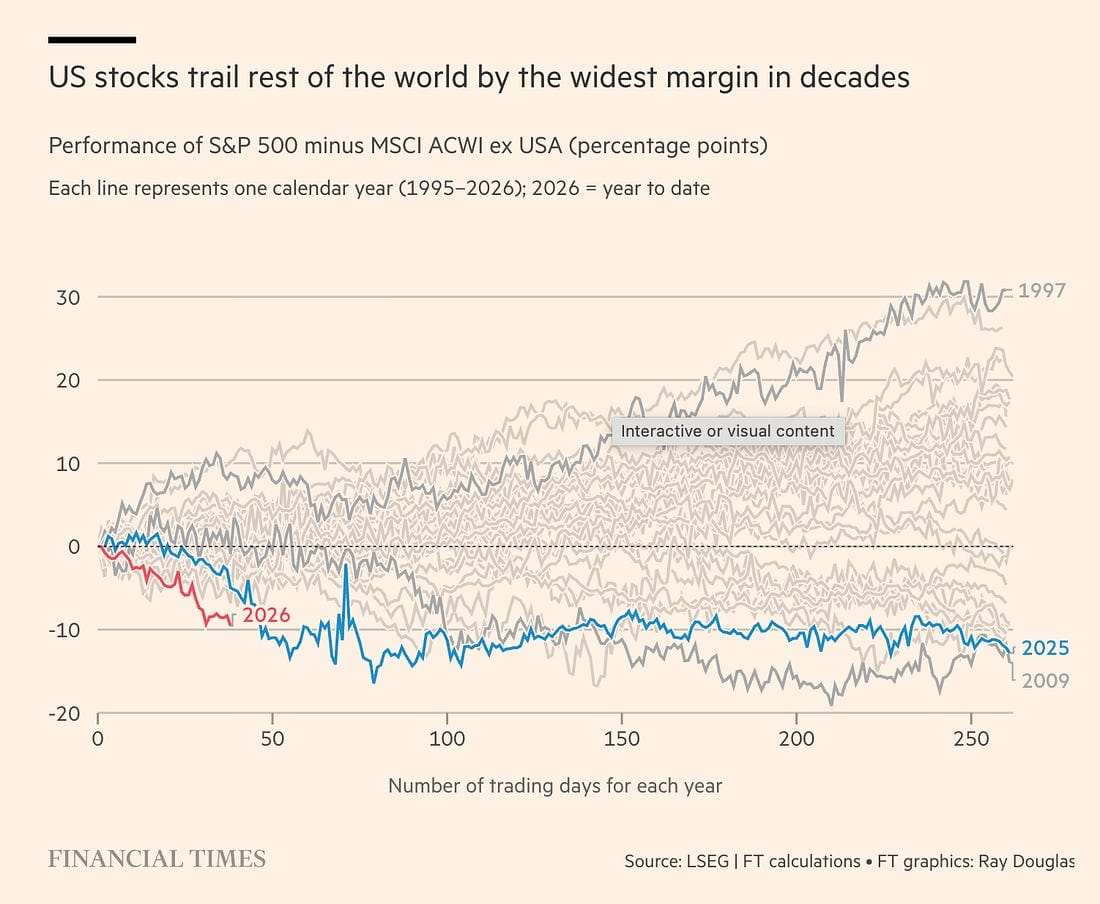
Not so great on the stock market — US stocks trail the rest of world by the widest margin in decades:
And on reindustrialization, we probably need to think harder about how to work with allies — from Noah Smith, Japan can be America's arsenal:
The United States needs to reindustrialize, but it cannot reindustrialize alone. Japan is its arsenal, already embedded in the most critical layers of the U.S. industrial base, from materials and automation to ship repair and advanced manufacturing. What’s changed is that Japan is now explicitly opening those layers to deeper co-manufacturing and co-development, and doing so under time pressure.
Epstein and Microsoft
This past week we learned the degree to which Epstein had reached into the ranks of Microsoft executives. Some Microsoft execs acted recklessly and cavalierly, meeting repeatedly with Epstein well after his original criminal conviction in 2009. This is damning to their reputations; they were all wealthy and powerful and had no reason to meet with the guy. And it is damning to the reputation of anyone who worked at Microsoft back in the day — it raises the question of “what kind of place was Microsoft anyway?”
But Microsoft execs and alumni are not the victims here. The victims are the women and children who were sex trafficked and abused. We should all be 1000% focused on helping them — and these wealthy men should lead the way. They should dedicate $1B, split across three efforts:
- An exhaustive independent investigation of the Epstein network. Who knew what when, who aided Epstein (doctors, politicians, etc), what really happened to cause his death, etc. Our justice system has failed to do the investigative work, we need to turn over every rock.
- Reparations to the victims of Epstein and any other child sex trafficking victims. These victims need far more support than they have received to date.
- And a deep study of our society and why it has tolerated or encouraged these behaviours. Why don’t we listen to the victims, why do we tolerate these activities when “everyone knows” what is going on, how have we sexualized girls and made it ok for men to fantasize about them. We need to identify social and policy changes we can undertake to better prevent the next Epstein.
The men named in the Epstein files — the Epstein association will dog them forever. They can spend their energy denying and distracting, or they can dig in and try to reform society and help the real victims.