Principles
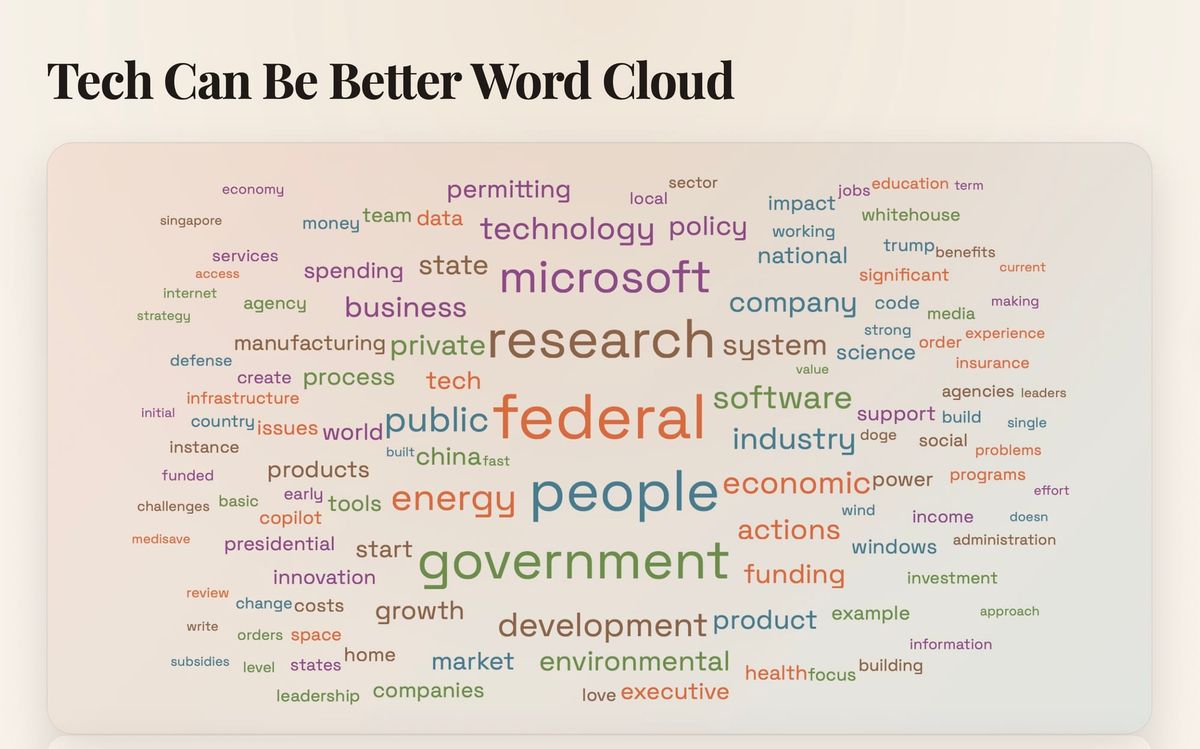
As I mentioned in the last several weeks, I've taken to creating an app a week using the latest AI tools – I don't have a prayer of understanding the AI wave unless I immerse myself. This week, I turned introspective and built a world cloud app for the newsletter. I am happy that "people" is near the center of the cloud, but sad that "federal" and "government" are there – a sign of the times and my inability to ignore the elephant in the room.
Also along these lines, Dare Obasanjo had a great idea this week – what do AI tools infer about my principles based on my writing? And here is what ChatGPT thinks my principles are:
- Human-Centered Technology: Tech should serve people’s creativity, capability, and dignity.
- Principled Thinking: Deep understanding beats surface level reactions.
- Agency & Autonomy: Individuals should control tools and choices that shape their lives.
- Constructive Civic Values: Democracy, rights, and fairness are essential to progress.
- Recognition of Luck: Systems should acknowledge happenstance and compensate fairly.
- Optimistic Realism: Be hopeful about the future, but honest and strategic about challenges.
I wish I was actually as structured and thoughtful as ChatGPT is claiming (and I probably need to tell ChatGPT to dial down the obsequiousness). But I certainly aspire to these principles or something like them.
Smart Homes Market Failure
Smart Homes Are Terrible. You shouldn’t need a tech tour and app to turn the lights on. I have broken my pick so many times on smart homes. I’ve installed a million devices myself, I spent money with architects and professional installers on a top-to-bottom smart home remodel, I did a startup that was focused on smart devices, and I’ve tried to build smart home apps. And the entire space sucks, flooded with cheap, unreliable devices or vendor-centric solutions that suck for end users and developers.
The smart home market lacks a compelling vision and market leadership. No one is working on the big problems. Smart home solutions won’t take off until basic issues of naming and location discovery are solved. I want to be able to say “I want more light here,” or “Play my Favorites playlist here,” or “Vacuum the kitchen tonight,” and have it work. We are a long way away from that, and none of the major vendors seem to be working on these problems; they continue to just sell visionless, siloed products.
Superbatteries
In contrast, I love what ARPA-E is pushing: Exclusive From The Electric: These U.S. Startups Are Developing Superbatteries for Long-Range Combat Drones:
ARPA-E’s aim is to more than triple the energy density of commercial batteries to at least 1,000 watt-hours per kilogram. The commercial state-of-the-art batteries used in drones today have energy densities of around 280 Wh/kg, although some startups claim to have batteries delivering 450 Wh/kg.
Now that is a vision — batteries 4x better than today’s. I hope they keep pushing and get to 10x, but I appreciate that batteries are hard. Anyway, this is a great example of government R&D support, more info here, and throughout the ARPA-E site. This is leadership.
This isn’t principled leadership
ARPA-E is the exception, though. Too much of our current government is focused on bullshit ideology. For instance, the SAVE Act. Here is a very good summary of election fraud by a normal human being. She dives deep into the Heritage Foundation reports, and the conclusion is that there is almost no voter fraud in the country:
That means, on the high end, the percentage of fraudulent votes is 0.000000245%.
The entire SAVE act is not about fraud, it is about taking the vote away from poor people, from working people, from people of color. It is not about making America great, it is about dividing and tearing us down.
This isn’t principled leadership either
And the parts of government that aren’t pushing nonsense ideology? Too many of them are chasing their own self-interest — Americans think everyone is corrupt. Yglesias does a deep dive into this and suggests some of the view is misguided. But I think it is pretty simple — almost without exception, federal elected officials leave office much richer than when they entered office. There is a ton of data on this:
- Personal Gain Index. Congressional representatives increased their net wealth by ~16% a year, while regular citizens saw their wealth increase by ~4% a year
- Getting rich in Congress. Most representatives are millionaires, and they didn’t start that way.
- The Wealth of U.S. Members of Congress. “…the average wealth of representatives grew over the 2004–2014 period in real terms at a rate almost seven times that of the 95th percentile of U.S. wealth holders.”
It is difficult to draw any conclusion other than corruption.