Time

As I age, my eyeglass prescription wanders, particularly the astigmatism component. I’ve been trying to adjust to a new prescription as of late, and it has been a killer. I have had to really whack down my screen time, and am still struggling with fatigue, headaches, and some depth perception issues. I’m headed back to the eye doctor this week to see if we should make some adjustments. Looking forward to the day when we have software-defined lenses that automagically adapt on the fly and deliver 100% correct vision!
Between my aging and this hopefully temporary limitation, I am super aware of time this week. Time is all we have; we have to be intentional about how we spend it. We will all run out of time, and there are a million things competing for our time each week.
The first successful software product that I worked on was Windows for Workgroups, which was just Windows 3.1 with networking built in. We had all kinds of fun and cool features in it, but ultimately, its success was due to just a couple of things. One, it made setting up a network much faster by eliminating all the MSDOS network configuration and installation work. Two, it had a 32-bit file system and read/wrote files much faster — and this was probably the most important feature because it touched everything people did. Not everyone used networks all the time in 1992, but everyone opened apps and saved files all day long.
Success was all about time. People are busy, their days are fully allocated, and they don’t want to spend more time futzing around with technology. They just want to get things done faster and with less fuss. This was true in the 1990s, it’s true now, and it will be true forever. Great products give people time back.
Noah Smith wrote this week about the challenges companies are having in converting token spend into real business value. But his best observation was about time:
But the internet didn’t just saturate our world; it saturated our time. There are a fixed number of hours in a day — it’s a unique, finite resource. For a long time, we kept spending more and more of those hours online. But this trend appears to have peaked during the pandemic, and may now be going into reverse.
We all have finite hours in the day, and they are all fully allocated. Any new product needs to clear this high bar — it has to save us time by displacing something we are already doing with a new way that takes much less time.
This is the same challenge software has been fighting forever — products need to automate away a bunch of cruft that people used to do, and they need to replace time-consuming processes. The best AI products have to give people back time that they can use in more meaningful ways. This is why Claude Code works, whereas ChatGPT does not. Claude Code eliminates hours I would otherwise spend on CSS, React, API calls, etc. ChatGPT just generates mountains of text that I have to do something with.
Lionel Smoler Schatz at Verdad argues that it is time to be an aggressive user of AI but a wary investor, because most of the economic value is accruing to users:
Speaking personally, the workflow I had as a new hire at Verdad three years ago would be unrecognizable to me today. I expect the same to be true three years from now.
When I entered the industry, much of the discussion around AI centered on displacement: junior analysts replaced, research functions hollowed out. My experience has been almost the inverse. The reasoning and domain expertise required for the work matter more than they did before, not less.
As the models improve, the bottleneck has shifted from, “How much can I personally type and debug?” to, “How clearly can I think about what to build, and how rigorously can I review what’s produced?”
AI is creating substantial economic value, but much of that value currently accrues to users rather than to the firms financing and building the infrastructure.
For investors, the implication is clear: Be an aggressive user of AI but a selective investor in it.
This is perhaps obvious, but it is completely reasonable and valuable to spend time with the AI tools now, even if you throw away the work you do with them (as I have done with 5-6 apps I’ve built). It is time to understand the tools, their limits, and what they are really good at, and you can only gain that understanding by using them and making mistakes. This is not a waste of time — every dead-end is a valuable lesson learned.
Erin Paige has some good counsel on how to use LLMs (the bold face is mine):
I am having a lot of difficulty explaining to people how I would prefer if they used AI LLMs as a kind of thinking partner rather than to think for them.
Two scenarios:
1. If I ask a technical question and you want to get all your notes messily down and then into AI and have it structure that for you, or pick out gaps in the thinking that you might consider more, or even get it to argue against you in what you think my persona might be so you can create a defense: Great.
2. If I ask you a technical question (X) and you feed that question to an AI LLM and say, Erin asked me X how can I respond so she does what I want her to do? It spits out something I not only see through immediately, it also rarely spits out anything correct or that I want because if the answer was in the AI LLM I would not have asked it.
So then I can't move forward. We cannot progress by relying on the regression of the LLM to think for you, to form opinions for you. You must still think.
LLMs don’t do the thinking for you. They are great at finding details, recalling details, reviewing work, finding holes, etc. When I ask them to do primary writing for me, this just wastes tokens and wastes time. They are a partner, not a replacement.
As great as Claude and other tools are, they are immature and stupidly resource-intensive. There is so much work ahead of us to make these tools more relevant, more stable, more efficient, more pervasive, more beneficial.
And that is part of what is exciting about Flourish Labs:
Flourish is a neuro AI company that is solving the two most difficult problems facing AI today: power efficiency and continuous learning. We are building Cortex AI, the first synthetic intelligence system designed to match the computational capacity, learning efficiency, and power budget of the human brain.
More at Wired. Thomas Reardon, Rob Williams, Ben Jones — great great great people, I look fondly back at the times I worked closely with some of these folks. My time as an operator is mostly behind me — but if I were earlier in my career, this is a great challenge, and these are great people. It is the people who really excite me about Flourish.
Torsten Slok at Apollo claims that AI is dramatically reducing the cost/complexity of business formation, which is thus causing a spike in new business formation:
The surge in new US business formation is being fueled by AI and large language models, which are dramatically reducing the cost and complexity of launching a company
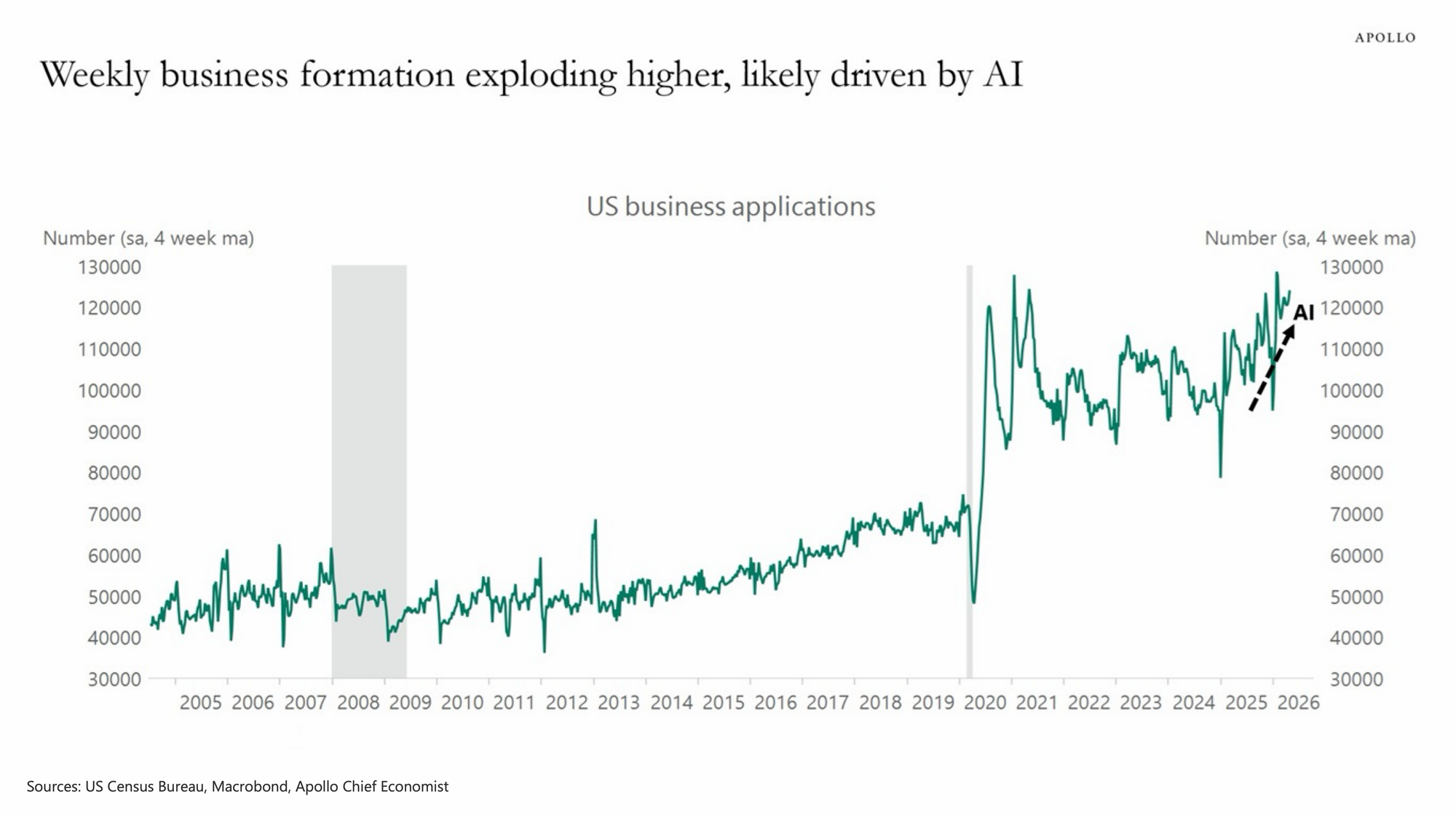
He may be overstating the case for AI, but business formation is a superpower of our country, and we should do everything we can to remove barriers and speed up the rate of business formation. By the way, this is one of the strongest and most overlooked arguments for universal health insurance — it is so silly that we ask small companies to waste their entrepreneurial time figuring out health and benefits plans.