Washington State Income Tax Thoughts

I’m having some cognitive dissonance around Washington State tax policy. We are a progressive state, I am ok with paying for a strong set of social services, and we have a regressive tax structure, so I get the arguments for an income tax in place of a sales tax. It is progressive dogma that the state needs an income tax — it’s kind of impolite even to question it.
And this tax won’t affect me. Our income is below the $1M floor. I am an old Medicare-eligible geezer — my income will only be dropping in the future. I suppose if ultimately the $1M earnings floor creeps lower (which it probably will, that is the story of taxes), maybe someday it will affect us, but I am betting the grave gets me first. So I don’t really have a personal stake in this.
So the tax won’t affect me, and I’m expected to support it. But I have questions.
What is the proposal?
Governor Ferguson is backing a proposal to impose a 9.9% tax on annual earnings over $1M, aiming to raise as much as $3B annually for the state. The governor says we need this for affordability:
“We are facing an affordability crisis. It is time to change our state’s outdated, upside-down tax system to serve the needs of Washington today. To make our tax system more fair, millionaires should contribute more toward our shared prosperity,” Ferguson said.
He also says he wants the money to be targeted towards the lower-income families in the state:
Ferguson said he wants some proceeds of a millionaire’s tax to be dedicated to tax breaks for lower income people, such as through expanding the state’s working families tax credit or cutting sales taxes. (FYI, the Working Families Tax Credit info is here; it is meant to refund part of the sales tax that lower-income families pay. You can see annual performance stats here)
The state is facing a budget shortfall, but the Governor says it won’t be used for that purpose:
The new tax would not solve the state’s immediate budget shortfall, Ferguson emphasized Tuesday.
There is no proposal to replace the existing sales tax with an income tax.
Will it affect affordability?
The costs of services, in many cases essential services, are an increasing burden for everyone. The prices of stuff — cars, appliances, clothing, tech — generally are performing well. But the costs of healthcare, education, childcare, and housing — these have moved in the wrong direction for people. We need dramatic reductions in these costs or dramatic increases in household income.
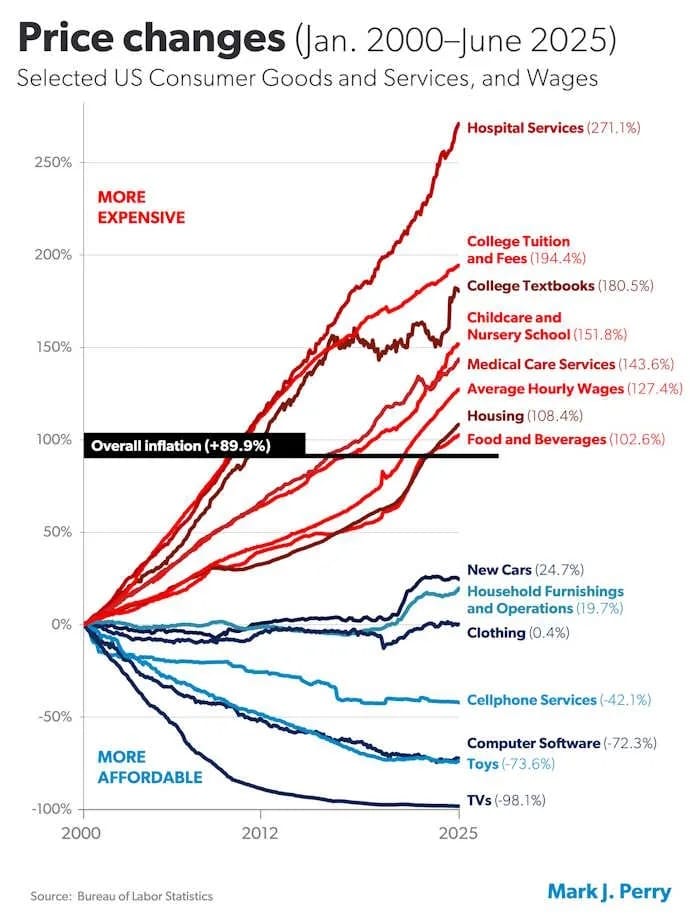
So I applaud the Governor and the Democratic Party for discussing this issue and seeking solutions. But will a new income tax affect affordability? Will it dramatically increase household income or significantly impact the costs of these essential services?
The tax is projected to raise as much as $3B annually. There are 3 million households in the state of Washington. Let’s say the state spreads it out with absolutely no overhead cost to every household — that is $83 a household a month at the most, assuming no administrative costs and no monies lost to fund other budget shortfalls. You can judge for yourself how likely this is.
With average household consumer debt of $20K+, with students carrying $39K of debt — $83 a month is immaterial. Certainly targeting it to the most needy households will help, but this is not going to change the affordability crisis for most people. People need $1000s more in income each month, or $1000s more in cost savings, to really start to impact their debt load and quality of life, and the state has no plan to do that, and probably no real ability to do that.
Recent state tax experience is not inspiring
Washington State enacted a capital gains tax several years ago and has raised almost $2B from it over the past 3 years. The money is intended for education. So where has that money gone? It has funded a bunch of construction projects. It has funded some pre-K programs. It is impossible to find a complete, detailed accounting of where this money has gone on the state’s websites.
Many reports suggest that Washington State education is not performing well — Washington stuck mid-pack in national education ranking, Washington is in the bottom half of states for education and economic well-being, WA education ranking drops again, below national average.
I would love to see a summary chart of exactly what problems these funds are trying to address, exactly what progress has been made, and exactly what the targets for progress are over the next 5 years.
Asking for a significant new tax, when the state is unable to clearly state the uses and benefits of its most recent large tax increase — well, that doesn’t sit well with me.
Taxing high earners is too late
For someone to be a really high earner in our state, typically the sequence of events is:
- They start an early-stage company and allocate a bunch of low-value equity to founders, employees, and investors.
- They work hard for many years, and most companies fail, but a few turn out to be highly valuable — Microsoft, Amazon, Costco, Starbucks, T-Mobile and other cellular firms, Expedia, F5, Zillow, etc.
- The founders, employees, and investors eventually sell some of that stock — though some of them decide to depart for greener tax pastures before they sell it, taking the potential tax revenue with them (e.g., Jeff Bezos).
- The state taxes those earnings and attempts to redistribute them through a complicated political process.
The entire process is significantly delayed, uncertain, hard to budget, and very centralized, which creates political problems. And there is considerable potential for loss, as high earners can simply leave the state.
If we want to spread the wealth, let’s do it from the get-go. Mandate greater employee and community equity sharing. Every employee should have equity; every employee should share in their company's economic success. And allocate some equity back to the local community — Microsoft’s success should be shared by every Redmond resident — teachers, utility workers, retail workers, etc. The rising tide of Microsoft should lift the boats of everyone around the company.
An income tax doesn't address the real problem with billionaires
Billionaires, per se, aren’t the problem. Suppose billionaires spent all their money on yachts and houses and show horses and gold trinkets – good for them. The problem is that some billionaires pour some of their money back into politics, creating a louder voice for themselves in the political process. That is the problem we have to attack, overturning the Citizens United ruling.
The income tax proposal seems ill thought out
We have real problems in this state: affordability, housing, education — all fundamental issues. But I see no evidence that this tax will help any of these issues. It is not targeted at any major affordability issues; the state has not demonstrated good fiscal management, it doesn’t do anything to really spread out the state's economic success, and it doesn’t address the distortions of money in politics. I want to see us actively work on those problems; the income tax proposal seems like a divisive side show.