Microsoft, AI, and Corporate Citizenship
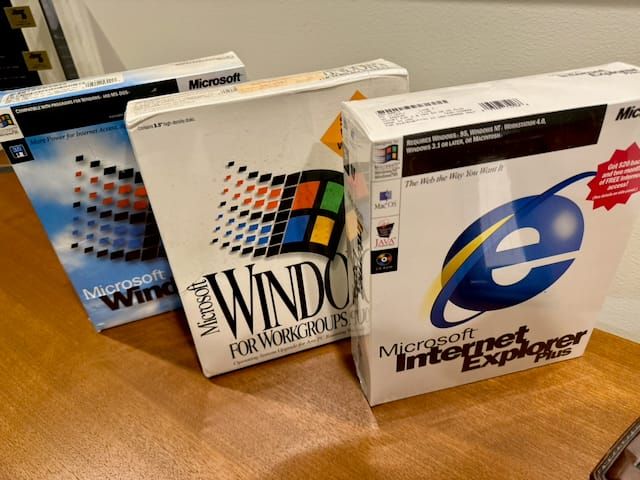
I look back fondly at my time at Microsoft in the 1980s and 1990s. We built products I remain very proud of — Windows95 and Internet Explorer right at the top. We had great people and great teams. I made some lifelong friends there.
And the company had great ambition. We were trying to change the world — bring personal computer power to everyone. The company took on many challenges to push compute power and programmability everywhere: OSes, Apps, Dev tools, sure. Server software of all stripes. Processor add-on cards, mice, keyboards, joysticks. PCs. Gaming consoles. Games. Internet TV. Software in office equipment, in cars. Phones, tablets, PDAs, toys, watches, music players, speakers. Portals, search engines, travel booking, car sales. A news magazine and news network. Books and magazines. Internet access services. Mainframe connectivity. Social networks. Maps. Wine guides, encyclopedias, dog guides. And probably 100 more I forgot. And for every one of these ideas that shipped, there were probably 50 more ideas that were considered and left undone.
The company was willing to try anything to grow the industry. Some of these ideas were great. Some not so. Some were just too early. The company wasn’t perfect; it made some mistakes and missteps, but it had ambition, an appetite for risk, and a long-term growth focus.
And so I am disappointed this week, because the company seems to have misplaced its ambition and vision. And I am suggesting some ideas for how the company can do better.
Eliminating jobs is not leadership
Microsoft just had a great quarter. Microsoft is one of the few companies actually making money from the AI wave: $36+ billion in profit last quarter, with plans to spend $170 billion on chips and data centers. And its big idea for addressing the dislocation AI is causing? Ease a bunch of people out the door.
Microsoft just offered buyouts to roughly 60,000 employees, about a quarter of the company, with this corporate-speak offer. Sixty thousand people. When I left Microsoft in 2000, the whole company had about 39,000 full-time employees. The buyout pool is half again as large as the entire company I worked at. And yes, maybe only a fraction will take it, but the signal and intent are there. And this is in addition to the recent layoff in the games division, and the retirement program and layoffs earlier in the year.
The memo calls this "a new choice" and "another way to adapt their workforce to changing needs." Which is just doublespeak, presenting this as a boon to employees. In fact, the company’s leadership has no idea what to do with the people it has after convincing them to join, and the best idea they could come up with was to get rid of them.
If the company best positioned to profit from AI can't figure out how to keep people working through this transition, who will? Is it OK for a leader to say "Gosh, this AI stuff is disruptive to our business and to society, but we're just going to wash our hands of it"? Microsoft really can't identify any investments to make with these people? Software and computing are all solved? Is knowledge work all figured out? All of the ambition of the 80s and 90s is gone?
Do better for current employees
I don’t pretend to know the right path for dealing with the impacts of AI. I doubt anyone knows yet. But that doesn’t excuse inaction or worse. It is a time to try some things, and to be tolerant of missteps. History is full of examples of companies that have tried successfully to protect and grow their people in the face of economic shocks, and Microsoft can afford to be a leader. Here are a few ideas:
- Share hours and gains, not just cuts. Offer reduced-hours options and paid retraining sabbaticals before any exit, and pay part of the AI productivity gain back to the rank and file as an annual dividend. In 1930, Kellogg moved to six-hour shifts so it could hire 300 more people during the Depression. Lincoln Electric (a company I almost took a job at) hasn't had a layoff since at least the early 1950s; in bad years it cuts hours, not people.
- Redeploy rather than layoff. Offer new roles or a funded path to one. Set aside 1% of the AI build-out, about $1.7 billion, for a fund that pays small teams to pitch and build new things. That is thousands of people building, not leaving. Many of these efforts may come to naught, but view it like a venture portfolio — there will be some big winners. IBM spent seven decades retraining and moving people rather than laying them off. Ingka, the largest IKEA franchise, replaced customer service reps with an AI bot, and instead of laying off people, retrained 8500 call center workers as remote interior design advisors, generating as much as €1.3 billion in sales in 2022 (though that may not all be attributable to the retrained employees).
- Turn exits into ownership. Anyone who leaves can start a company with Microsoft seed money and Azure credits, with founders and employees holding the majority. Rather than have people leave with a sour taste in their mouth about Microsoft, let them leave with some excitement and a chance to grow the Microsoft ecosystem.
- Write the playbook for other companies. Track the results carefully of all the above and report out best practices for others to adopt, and offer to train them using some of the employees displaced by AI. This is super important; Microsoft can lead by example for the entire economy.
Companies have faced economic shock challenges before — some technological, some social. The best companies treated keeping and growing their people as an opportunity, not as a cost to be excised.
Use its voice
Microsoft shouldn't stop at its own payroll. Microsoft has access to the levels of government where the rules for the AI economy will be written, and it has the ears of politicians in both parties. It can step up and do some of these:
- Back an AI transition tax, and pay it before it's law. Bill Gates wants to tax tokens. Anthropic's Dario Amodei has floated 3% of AI revenue. A House bill would start at 2% to 3% and rise automatically as unemployment rises. Microsoft should endorse a levy like this and start paying a voluntary version into a fund for displaced workers now.
- Stop the tax code from paying companies to replace people. Economists led by MIT's Daron Acemoglu estimate that labor is taxed at more than 28.5% and software and equipment at about 5%. Microsoft should lobby to close that gap even though it raises its own taxes.
- Put AI ownership in everyone's hands. Alaska has paid its residents an oil dividend for decades. We could do the same with AI. Microsoft should push Congress to let companies pay shares straight into the new children's investment accounts, and sign a public pledge to share windfall profits above a high threshold. Anthropic said it plans to put 5% of its shares into a new public benefit fund that can address "the public good," including mitigating AI's impact on the job market, with the stake growing as the company's value rises. Even Elon Musk, no one’s model citizen, has pledged a share of SpaceX to each American child, posting the move right after Anthropic's announcement.
- Create a GI Bill for the AI era. The 1944 GI Bill put 7.8 million veterans through school or training and returned about $7 for every $1 per one estimate. Every adult should get a lifelong learning account, and Microsoft should offer its training and job data as public infrastructure to make it work, starting in Washington State.
At least try
I don’t know what the right responses are to the dislocation caused by AI. I doubt anyone knows the exact right answer. Maybe these are dumb ideas. None of this is radical. Every one of these ideas has been proposed by serious people or tried somewhere. The key thing is to start trying and to learn as we go.
Ultimately, voters and politicians will decide what to enact, but Microsoft can lead the way. Microsoft has the money, the talent, and the political clout to show US industry how to get through this transition with its people. And in the new “blue wave” political climate, where anti-data center and anti-AI sentiment is gaining power, Microsoft and other industry leaders should probably try to get out in front of the issues, or they are going to find solutions forced on them.